Personal website is live
15.10.2026 · 4 min read
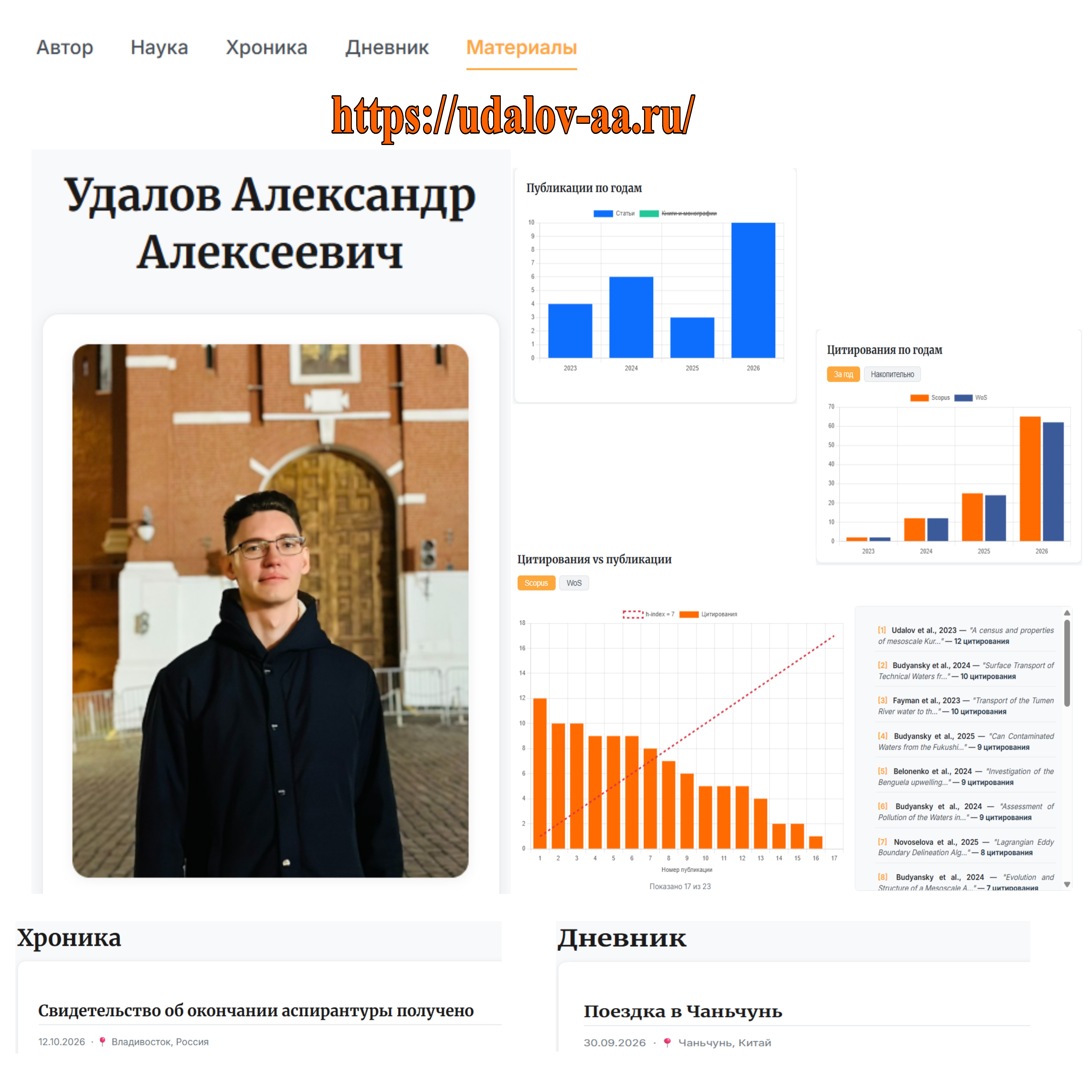
For the past two years I've been putting together my personal website piece by piece — and now it's finally live.
Here you'll find lecture materials for students, breakdowns of algorithms for colleagues, and everything that's accumulated over five years of teaching.
I started it like building with a construction set: first one piece, then another, then you notice how they connect, and you want to add a third. Honestly, I thought I'd abandon it after a couple of months, as usually happens with side projects. But I didn't — because every time something new starts working, it's a small joy. It's that feeling of "just a bit more, and it'll be like this" that keeps the site alive, rather than gathering dust in a folder called "abandoned".
The idea didn't come all at once. I've been teaching programming students for five years now — since the day I finished my master's. I often heard them discussing their projects in other courses: someone building a website, someone writing an app, someone figuring out databases. I listened and listened — and thought, why not try it myself? Especially since I'd accumulated a lot of things I wanted to gather in one place.
I decided to make it public: it's more honest that way — when you know someone might visit, your hand won't let you leave a section empty. And locally, it will get lost sooner or later anyway. Besides, loading everything in one go is exhausting. Better to do it gradually.
What's more or less ready
Author — a short block about me and scientometrics. So that I don't have to search across a dozen websites and profiles, everything is gathered in one place.
Science — publications, citations, statistics. Plus charts that update automatically as the data changes.
Chronicle — research notes about what's happening in my work. Something like a diary, but only about the professional side.
Journal — personal entries, including from my travels. This is where things go that don't fit the academic format but that I want to share.
What's just beginning
Materials — a section with lecture notes. It's still in closed access and is being filled gradually: a few topics have appeared, but it's far from a full course yet. I'll open it when there's something to show.
And now about the plans — the most interesting part
There are two lines here, and both came from requests I hear constantly.
The first — for students. I teach programming students, and I want this section to be useful for everyone. First, it will cover the topics we go through in lectures — at a calmer pace, with examples and explanations you can come back to after class or before an exam. Sometimes there isn't enough time in a lecture to properly unpack something, but here that can be done right. Second, besides the core material, there will be topics that go beyond the course. I hear this all the time too: the group as a whole can't handle certain material — not because it's bad, but because it's too early to give, or there isn't enough time. But one or two students are genuinely interested, they want to dig deeper, and in a lecture I can't make room for that — the rest won't follow, and the syllabus doesn't wait. Before, this stayed unanswered. Now I want to publish such breakdowns here — both for those who need to catch up and understand the basics, and for those who want more.
The second — for colleagues. I work on developing numerical methods — for example, two of my recent papers: an algorithm for tracking hyperbolic and elliptic points in non-stationary fields (HEPTA) and a method for extracting the core of jet streams using an ensemble of streamlines (SEAMT). Colleagues usually use these methods, but they don't always understand what's inside them and how they differ from existing ones. And that's normal: they don't have the time or the opportunity to go through as much material as I had to, back when these works appeared.
I want to explain this in plain language. For example, how HEPTA tracks a vortex center continuously, where other methods (like AMEDA) can lose the trail if the vortex contour temporarily disappears — due to noise in the data or insufficient grid resolution. With AMEDA, the trajectory breaks; with HEPTA, it doesn't, because it follows the center itself, not the contour. It's not obvious, but it's critical if you work with long time series or noisy data. These are the kinds of things I want to explain — in plain terms, with pictures, and where possible, with interactive elements. So that you see not just "what it does", but also "how it's built" and "why exactly this way".
Plus, over time, the site will feature breakdowns of research problems and topics that usually seem difficult.
This is all just the beginning. And, honestly, I'm curious myself where it will lead.